This is the third part of a series on using Blender Geometry nodes to make some pretty patterns on the Poincare disk .
So far I made a tiling of the Poincaré Disk, but for simplicity I drew the tiling edges with straight lines. The edges in the tilings should really be arcs because in Poincaré geometry the shortest distance between two points is a geodesics or circle arc.
I found it easiest to replace the edges after constructing the tiling. I used two nested “For Element “ loops. The outer one iterates over every face in the tiling, the inner one over every edge in the face. This duplicates calculations but it’s fast enough, so no optimisation needed.
Inner loop
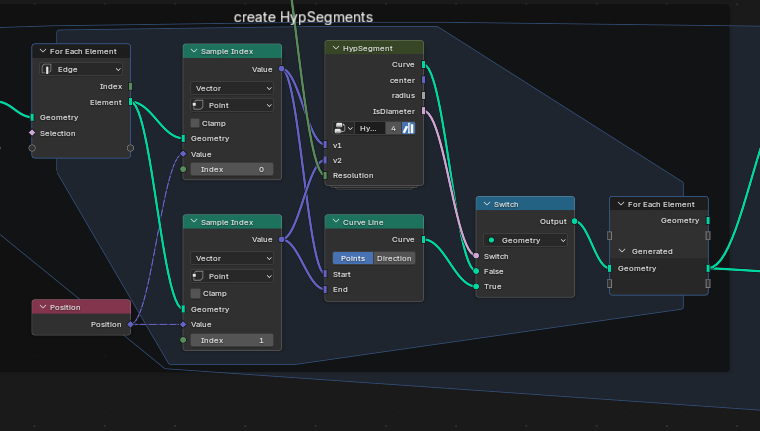 The inner loop is simple and just creates a
 HypSegment through the two points of each edge on the face.
Outer Loop
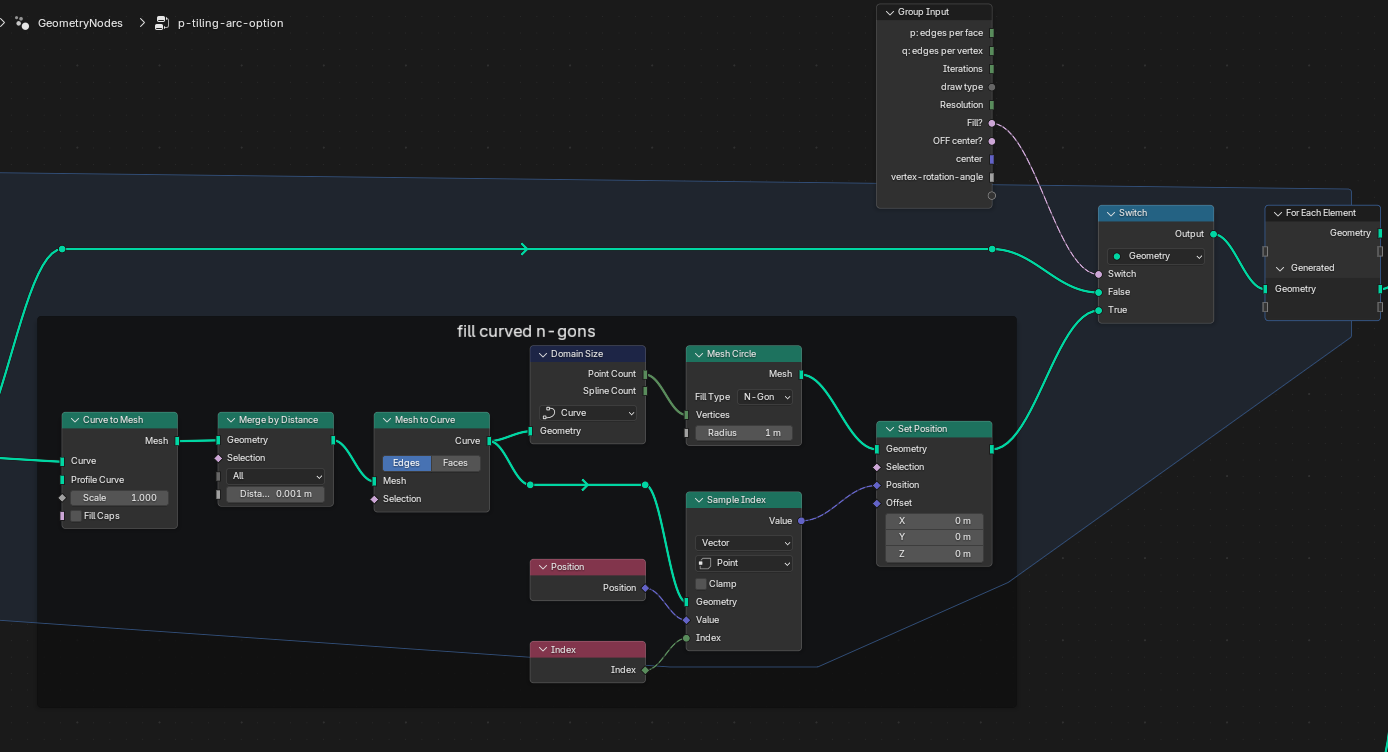
The outer loop (optionally) fills the curve with an n-gon. The Curve to Mesh ` Merge by Distance Mesh to Curve` node sequence, merges the extra vertices at the face corners and sorts the vertices into sequential order. After that we replace the curves with a filled mesh circle with the appropriate number of vertices, then set the vertex position to that sampled from the curve.
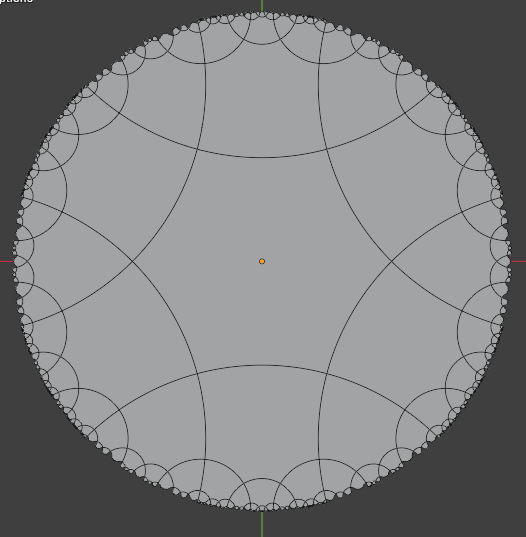
The full node group p-tiling-arc-option in the available blend file. has some other draw options.
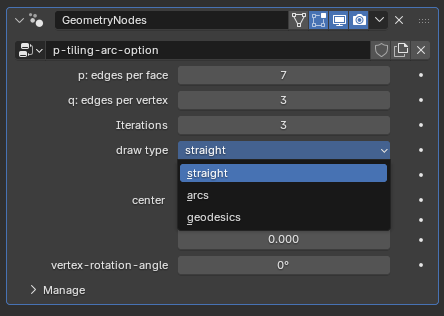
geodesics draws a full HypLine between the ideal points on the edge of the Poincaré Disk (the unit circle) for every edge.

The off centre options allow the polygon that starts the tiling to be displaced from the origin. Setting this up involved creating some more basic tools for working with hyperbolic geometry.
h-distance- the length of the geodesic between two points- h-circle - the euclidean centre and radius of a hyperbolic circle.
h-distance
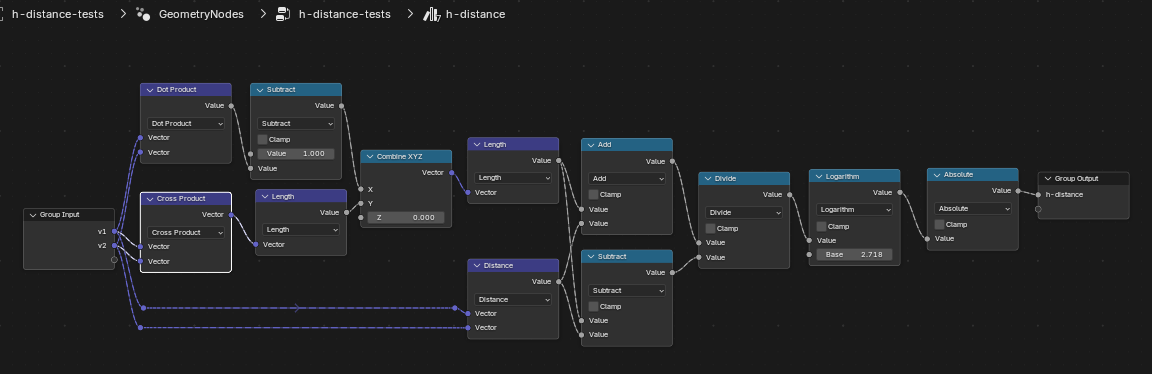
The hyperbolic distance is the shortest distance between two points in the Poincaré Disk. A derivation is given here - GCT Measurement in Hyperbolic Geometry that doesn’t require finding the ideal points of the geodesic. The result there is given in complex number notation.
\(d_H(p, q) = |\ln{(\frac{|1-\overline{p}q|+|q-p|}{|1-\overline{p}q|-|q-p|})}|\) where $p =p_x +ip_y$ and $q= q_x +iq_y$ are complex numbers and $\overline{p} =p_x -ip_y$ is the complex conjugate of $p$ swapping to vector notation $P=(p_x, p_y)$ and $Q=(q_x, q_y)$,
\(\overline{p}q = (P\cdot Q, |P \times Q|)\) $P\cdot Q$ is the dot product and $|P\times Q|$ is the length of the cross product. or in math formula extension notation
ng h_distance(P: vec3, Q:vec3) -> hd: float{
	qp = dist(P,Q);
	ccpq = length({1 - dot(P, Q),length(cross(P, Q)),0});
	out hd = abs(log((ccpq + qp)/(ccpq - qp), #e));
}
h_distance({0.5, 0, 0}, {0, 0.5, 0});
h-circle
For a hyperbolic circle all the points are an equal hyperbolic distance from the hyperbolic centre. It can be drawn as an Euclidean circle with the Euclidean centre $B_E$ offset from the hyperbolic centre $B$ on a line toward the origin $O$.
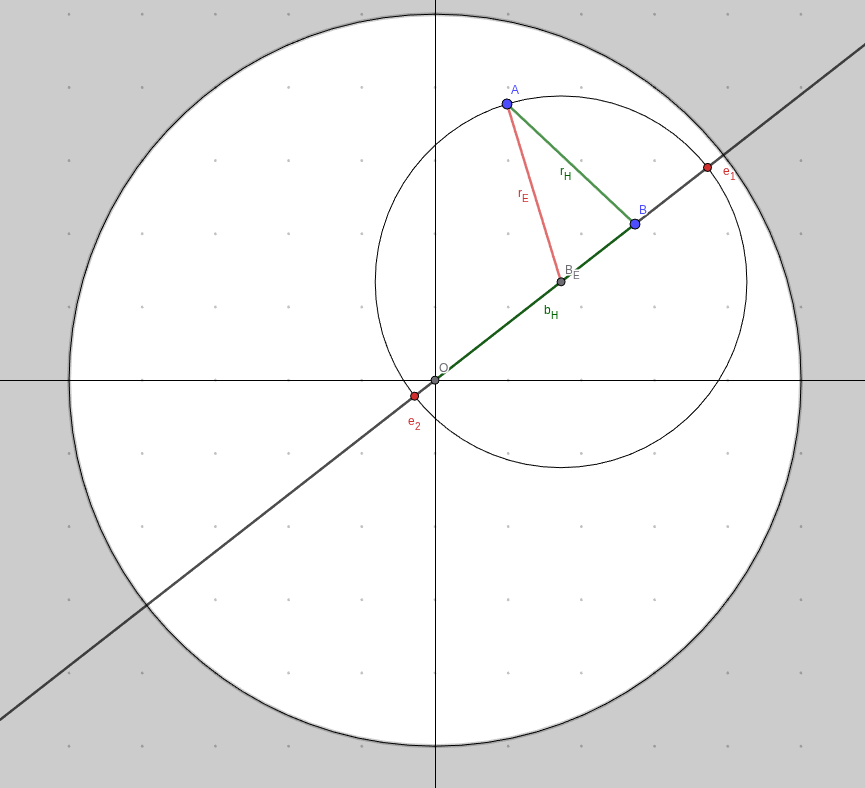
Distances from a point to the the origin of the Poincaré Disk can be converted back and forth from hyperbolic $d_H$ to Euclidean $d_E$ distances via
\(d_H=|ln(\frac{1+d_E}{1-d_E})|\) \(d_H = 2 \tanh^{-1} d_E\)
and \(d_E = \tanh(\frac{d_H}{2})\)
where $\tanh$ is the hyperbolic tangent function.
Using this we can find he Euclidean centre $B_E$ of a hyperbolic circle, centre at $B$, through $A$
\(r_H = d_H(\overline{A},\overline{B})\) \(b_H = d_H(\overline{B},\overline{O})\)
\[e1= \tanh(\frac{b_H+r_H}{2})\] \[e2= \tanh(\frac{b_H-r_H}{2})\] \[B_E = \frac{e1+e2}{2}\frac{\overline{B}}{|B|}\]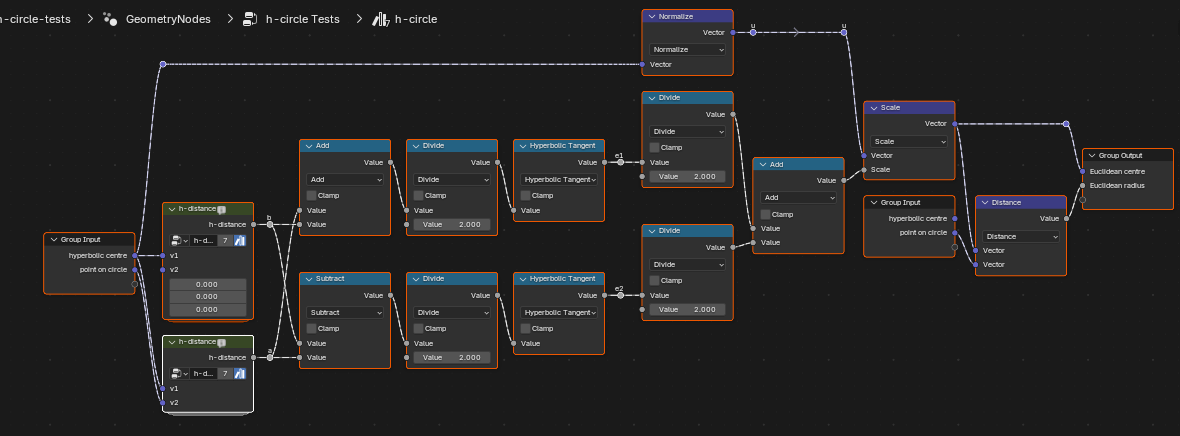
Now I have the h-circle group, I can use it to find the perpendicular bisector geodesic of the desired centre of a hyperbolic polygon and the origin. then I reflect a polygon at the origin through this geodesic to place the vertices of the off centre polygon.
The hyperbolic perpendicular bisector construction is analogous to the familiar Euclidean one. Draw a circle centred on A through B, and another circle centred on B through A. Find the two intersections points of these circles. Draw a line though them.
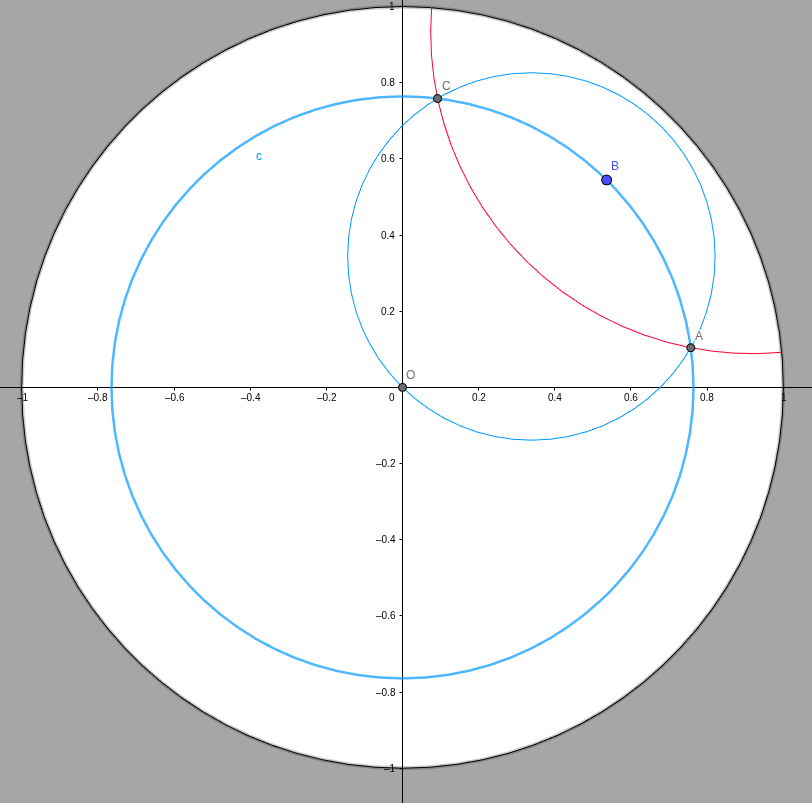
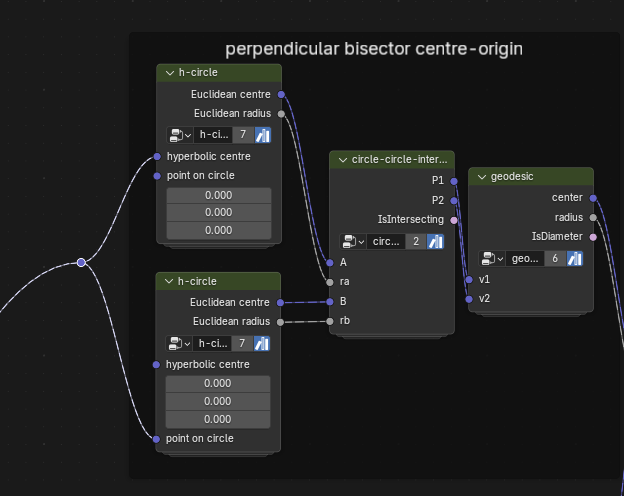
And the full off-center-polygon group
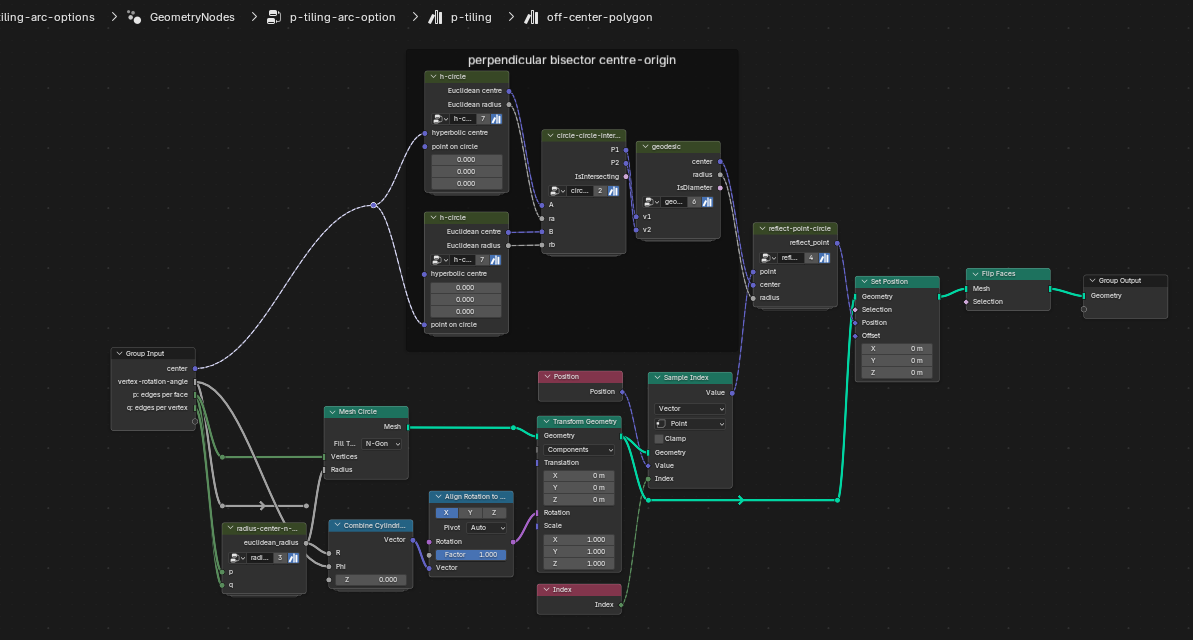
This is incorporated into the p-tiling group,within the p-tiling-arc-option to produce Poincaré tilings with an off centre polygon.
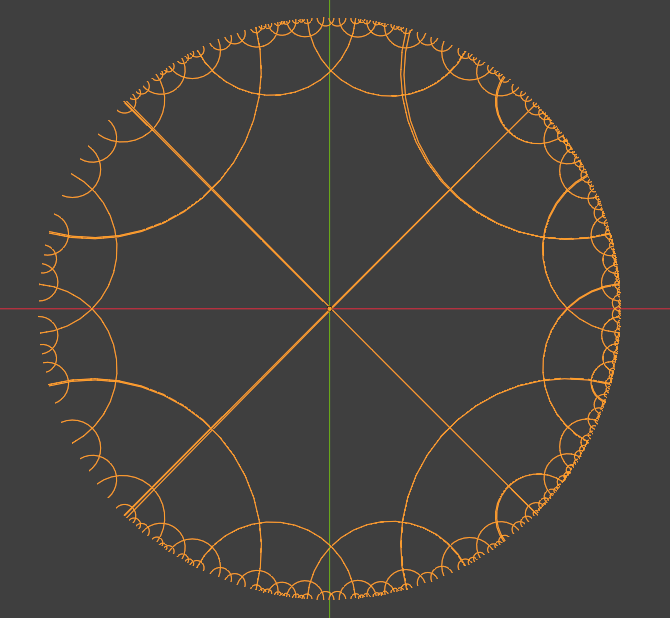
The off-center-polygon can also be used to draw other patterns.
Here a hyperbolic line is drawn through the centre and each vertex of a polygon.
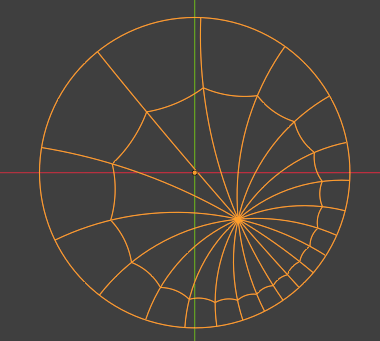
So that wraps this series for now. Although I have some ideas for hyperbolic solids in 3D …
All the hyperbolic tools can be found as assets in the provided blend file. Most of the pretty pictures are available in the “demos” collection in that file. There’s also a “tests” collection, that has tests for the h-circle and h-distance groups. I needed to rewrite these two groups as I refined and simplified the maths. I wanted to find a way to use tests in a similar way that I would use with text code. I think this works.
Overall, this was a great learning exercise. I’ve improved my ability to implement maths and geometry in Blender Geometry Nodes heaps. I feel I’ve got my fingers over the edge of the learning cliff and can now pull myself up. Hopefully, I’ll document some more of this here on the blog.